Your configuration
TW610 8.4 UG
- Range
- Portable
- Bay length
- 4 m
- Tire rotations
- 1
- Water treatment
- 8 kl settling tank
- Tank position
- Underground
- Sludge removal
- Manual — cleared on schedule
Sonuçlar yalnızca Türkiye sitesini kapsar.
Wheel & dust control
Keep site mud off the public road at the one place it leaves — the exit. Automatic drive-through wheel wash systems that install in a day and recycle up to 90% of the water they use.
Deployed and commissioned — no foundations, no cure time
Wash water recycled in a closed loop, every cycle
Vehicles per hour through a single 4 m bay
Splash guards above the drive surface — the highest in the industry
A construction site tracks mud onto the public road at exactly one point: the gate. Everything else — the sweeper contract, the neighbour complaints, the sediment in the stormwater drain, the notice from the regulator — is downstream of that one crossing.
A wheel wash sits on it. Trucks drive through on the way out, high-pressure jets clear the tread and undercarriage while the wheel turns, and the water drops into a tank that settles the solids out and sends the water back round. Nobody holds a hose, nothing stops, and the road stays clean.
This page is about specifying one for a construction programme in Türkiye — how big, portable or permanent, and what the answer depends on.
Why it matters
Sediment tracked onto a carriageway is a road-safety hazard, a stormwater problem and, in most jurisdictions, a condition on the approval that let the site open. It is also the most visible thing a neighbour has to judge the site by. Manual hosing at the gate is slow, uses more water than washing does, and stops the moment the crew is busy — which is the moment the traffic is heaviest.
In operation
One pass, no stopping, no hose. The jets run while the wheel turns, so the tread is cleaned all the way round rather than at the four points it happens to be resting on.
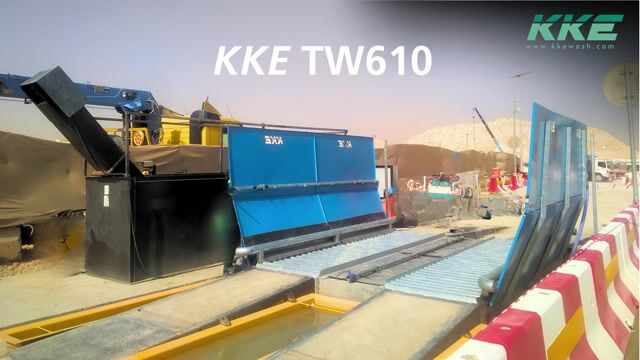
KKE TW610 portable wheel wash in operation.
Specify it
Four questions about the site, and you have a configuration you can take to a supplier — ours or anyone else's. The model code is not a product name so much as the answer to those four questions written down.
Your answers
Your configuration
TW610 8.4 UG
Your configuration
TW610 8.4 AG
Your configuration
TW610 40.8 UG
Your configuration
TW610 40.8 AG
Your configuration
TW610 8.4 UGC
Your configuration
TW610 8.4 AGC
Your configuration
TW610 20.4 UG
Your configuration
TW610 20.4 AG
Your configuration
TW610 20.4 UGC
Your configuration
TW610 20.4 AGC
Your configuration
TW610 40.8 UGC
Your configuration
TW610 40.8 AGC
Your configuration
TW610 60.12 UG
Your configuration
TW610 60.12 AG
Your configuration
TW610 60.12 UGC
Your configuration
TW610 60.12 AGC
Your configuration
TW620 8.4 UG
Your configuration
TW620 8.4 AG
Your configuration
TW620 40.8 UG
Your configuration
TW620 40.8 AG
Your configuration
TW620 8.4 UGC
Your configuration
TW620 8.4 AGC
Your configuration
TW620 20.4 UG
Your configuration
TW620 20.4 AG
Your configuration
TW620 20.4 UGC
Your configuration
TW620 20.4 AGC
Your configuration
TW620 40.8 UGC
Your configuration
TW620 40.8 AGC
Your configuration
TW620 60.12 UG
Your configuration
TW620 60.12 AG
Your configuration
TW620 60.12 UGC
Your configuration
TW620 60.12 AGC
Why this one
The configuration above is yours to use. If it is useful to have the rest of it — what to check on site before anyone quotes, what actually moves the price, and the questions an engineer will ask you — leave a name and a work email and it opens below.
We quote per project rather than off a list, because these five things move the number far more than the badge does — and every one of them is something you already know about your site:
Throughput bands map to tank capacity one-to-one in the ladder above, and real sites do not. The type of debris decides how long the water has to stand, so light, slow-settling material needs a bigger tank for the same truck count. Water demand per wash and your site's water quality move it again. The configuration you have is the right shape; the capacity is confirmed per project.
Configurations, bands and model codes are the same ones published on the portable and permanent range pages — this tool reads them rather than restating them. Final sizing is confirmed per project.
How it works
Entry ramps guide it onto the galvanised wash bay. Sensors pick the vehicle up and start the cycle — the driver does nothing and does not stop.
High-pressure nozzles are aimed at the tread, the sidewalls and underneath. The wheel keeps turning as it crosses, so the whole circumference passes through the spray.
Wash water falls into the tank under the bay. Multi-chamber settling separates mud, stone and grit. With a PCET trap fitted, a scraper conveyor lifts the sludge out continuously.
Filtered water is recirculated for the next vehicle — up to 90% recovery, so the system draws make-up water rather than a fresh tankful. The truck exits onto a clean road.
Where they go in
Cut and fill, where the spoil is leaving all day and the haul road is the site.
Long linear sites with a new access point every few kilometres, and a relocation every few months.
Feeding the job from the other end — aggregate out, all day, on a fixed exit.
Where the material is fine, the exit is permanent and the neighbours are close.
Short programmes on constrained urban sites, where the road outside is somebody's street.
The receiving end of the same truck movement, with the same obligation at its gate.
The two ranges
Almost every construction site wants the portable range: it is commissioned in a day, it needs no foundations, and it leaves when the project does — onto the next job. The permanent range is for the exit that outlives the programme, where the tanks are cast in concrete alongside the base.
Questions
Because mud leaves the site on tyres, and it leaves at the gate. In most jurisdictions preventing sediment tracking onto a public road is a condition of the approval the site operates under, enforced by the local authority or the environmental regulator. Beyond compliance it is a road-safety matter, a stormwater matter, and the most visible thing the neighbours have to judge the site by.
Bay length is set by how many trucks leave in the busiest hour, because bay length is how far the tread turns while it is under spray — a 4 m bay turns it once, a 12 m bay four times. Tank capacity follows the same bands, but it is also set by how long your material takes to settle, which is why light or fine debris can need a bigger tank for the same truck count. The specifier above works through it in four questions.
Portable, in almost every case. A construction exit moves, and a portable system is commissioned in a day with no foundations, then relocated across phases and onto the next project. A permanent installation earns its civil works where the exit outlives the programme — a quarry, a batching plant, a depot or a landfill.
Far less than it appears to, because the water is recirculated rather than consumed. Up to 90% of the wash water is recovered in a closed loop every cycle, so the system draws make-up water to replace what leaves on the vehicle and in the sludge, rather than a fresh tankful per wash. A crew hosing wheels by hand uses more water than the machine does.
A portable system is positioned, connected and commissioned within a single workday — no earthworks, no embedded track, and no waiting for concrete to cure. A permanent installation is on the programme of the civil works it sits in.
We quote per project rather than off a list, because the number is driven by things specific to your site: bay length, tank capacity, whether the water treatment is a plain settling tank or a self-clearing PCET trap, how much excavation the tank needs, and freight to site. Those five drivers are set out in full in the specifier above.
No. The tank can sit underground, sunk level with the slab, or stand above it — and the wash bay itself sits at slab level either way. It is only the tank that moves. Rock, a high water table, live services or a reinstatement clause are all good reasons to choose the above-ground tank, and none of them stop you having a wheel wash.
It settles out of the water in the tank below the bay and is removed as sludge. With a plain settling tank that is a scheduled job, usually done by plant that is already on site moving spoil. With a PCET scraper-conveyor dirt trap fitted — the trailing C in the model code — a chain-and-flight mechanism lifts the solids out continuously into a chute, so nothing is shut down to clear it.
That is what the portable range is for. The TW610 is a self-contained module on a galvanised base: it is lifted out, transported and recommissioned on the next exit within a workday. Sites running one to three years typically move a single system across several phases rather than buying per phase.
Tell us the exit, the vehicles and the peak hour. Our engineers confirm the bay length, the tank capacity for your material's settling time and the water treatment, and come back with a configuration and a price.
Request information
Tell us about the exit and we will come back with a configuration and a budget.